
Father’s Day Gift Certificate Special!
Home » Blog » 2023
How to Treat the Different Types of Acne Scars
Home » Blog » 2023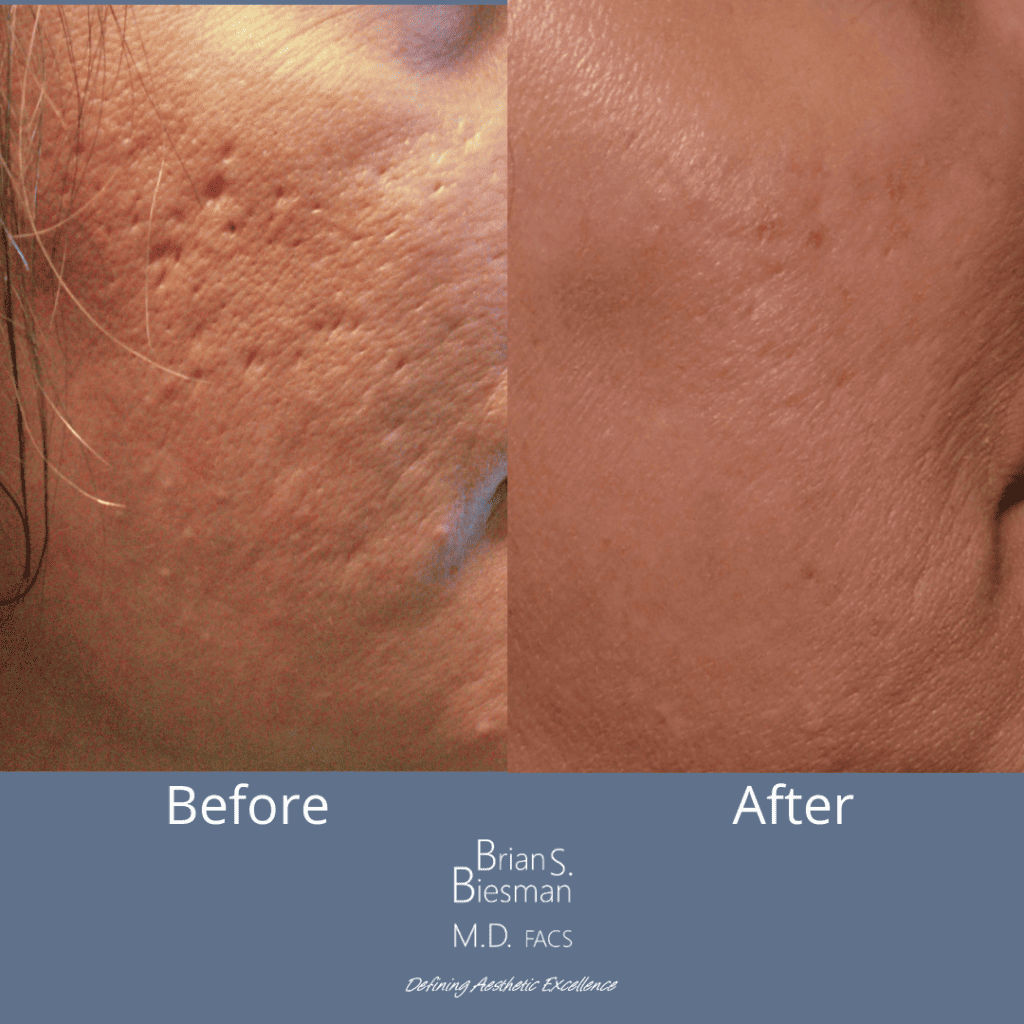
Acne scarring is a tough condition to treat. There are several different types of acne scars and each requires a unique type of treatment. For that reason, there is no single treatment that is “best”, because every patient’s scarring is different.
When we treat acne scars, our goal is to achieve the best improvement in scarring by removing or reducing irregularities in the skin surface.
Treating acne scars always starts with a conversation about expectations
Before starting treatment, I always discuss expectations with my patients.
Without exception, my patients who have acne scarring think it’s the first (and only) thing people notice, even if their scars are barely visible to someone else. During the consultation, we spend a great deal of time discussing expectations for final outcomes.
I tell them that the goal of treatment is to improve the appearance of the skin surface as much as possible. However, their skin will never be perfect or look as if they never had acne scarring. I advise patients that if their goal is to have scars fully eliminated, they should not undergo treatment as they are unlikely to be satisfied with their results. The last thing I want is patients to have a vision for an outcome that is not realistic.
I prepare all of my acne scar patients with the expectation that treatment is a journey. It will likely require a series of treatments spaced out every one to two months and for at least a year in order to get best outcomes, although I do expect to see improvement with each treatment.
I also caution my patients to be careful when looking at before and after photos, because acne scars are very hard to photograph accurately. For example, if you illuminate a depressed scar directly, it may not be visible. If you illuminate it from the side, a fairly shallow indentation may look much deeper.
With all these caveats about treatment, is it worth it?
According to my patients, yes.
I always ask patients what improvement they achieved after treatment, and the majority of patients tell me they see a 30-70% improvement in the appearance of their skin surface. Some are in the 90-95% range, and some patients say 10%. Even if they only see a 10% improvement, the majority of these patients are happy they sought out treatment.
The different types of acne scars
There are three main categories of acne scars: rolling, boxcar, and icepick.
The most common types of scars, rolling scars, are depressed. Rolling scars create wave-like depressions that aren’t sharply defined and shadowing in most lighting scenarios.
Boxcar scars are round or oval scars with steep vertical sides. They are wider than icepick scars and are typically more noticeable than rolling scars.
Ice pick scars appear as deep, narrow pits. They look like a scar made from a tiny ice pick or sharp instrument. Ice pick scars are very small but can be very challenging to treat.
How we treat acne scars
Sometimes, patients come to us for help with scarring when their acne is not under control. For some patients, their skin will never be without some type of breakout. In either scenario, it is important that active acne breakouts are controlled as well as possible before starting treatment of acne scarring. In these cases, we may coordinate care with a dermatologist.
To treat different types of acne scars, we first consider the three main characteristics of the scars:
- Contour – Are they depressed or elevated? If depressed, how deep are they?
- Skin Texture – What is the skin quality? Is it smooth and shiny or relatively normal?
- Color – Are the scars discolored? Acne scars can be the same color as the surrounding skin, or they may be pink, red, or even white.
We then create a treatment plan customized to each patient’s scars. We always identify a starting set of procedures. Subsequent procedure plans may be made depending on the response to the initial treatments. In this manner, we will come up with the best recommendations for them.
Surgery can treat depressed scars
The most common concern that we hear from patients is depression of the scars. This occurs mostly with rolling or boxcar scars. If a scar is depressed, it means the skin is bound down to the underlying tissue, causing shadowing or even a crater-like appearance. By releasing the scar tissue that is pulling down on the center part of the scar, the scar will no longer be depressed as much. Releasing a scar is accomplished through a technique known as subcision.
Subcision is highly effective
Subcision is a widely used term that can refer to a number of different procedures. Many subcision techniques are not particularly effective. Over the past 25-30 years I have worked to develop and refine a subcision technique that is highly effective in the treatment of depressed acne scars.
When we do subcision, we start by identifying the area to be treated. We like to make sure that we are seeing the same areas that will benefit from subcision as our patient. This ensures we treat all affected areas that are most important to them.
We then administer anesthesia. This involves a series of injections, which are not terribly comfortable. However, the anesthesia is extremely effective and once the treatment area is numb, the rest of the procedure is a breeze!
We use a special device to aggressively release the scars in the entire affected area, whether it’s the cheek, temple, forehead, area around the mouth, and/or chin. We can usually do this with a single-entry point on each side; no sutures are required.
Patients should expect to have some swelling and/or bruising, so I advise them to set aside five to seven days for recovery before they look their best.
Many of our patients have undergone numerous other acne scar treatments before seeking help from us. A large percentage of these experienced patient find that our subcision technique produces more improvement in their scars than any of their previous treatments combined.
Some patients also elect to undergo more than one subcision treatment. The timing of additional subcision depends on outcomes from the first treatment.
Punch excision is best for deep scars
Many deep pitted scars sometimes require punch excisions. With this procedure, we remove the scar and close it up with a stitch. We often will perform laser treatment of the scars at the same time in an effort to achieve best outcomes. The sutures are removed a week later.
Laser treatments often follow surgery
Subcision and punch excision improve skin contour, but they don’t treat skin texture. Therefore, surgery to treat different types of acne scars is often followed by laser treatments. We have a wide variety of treatment options available.
As I mentioned above, it can be difficult to predict which treatment will provide the best response to some acne scars. We may treat a patient with a particular device and upon follow-up feel that better results may be achievable with a different approach. In this situation, will recommend making a switch for the next treatment session. I always start with the treatment combination I believe will have the best likelihood of success.
We often recommend treatment with a laser, such as UltraClear Laser or Fraxel, or another energy-based device like Morpheus 8 radiofrequency microneedling. This can be done at the same time as subcision to improve skin texture and quality. A series of additional laser or Morpheus 8 treatments are typically required at one-month intervals.
UltraClear laser resurfacing is one of my favorite treatments to use in the management of acne scarring. UltraClear is the world’s first cold fiber laser solution that offers patients fast treatment sessions (between 10 to 15 minutes for a full face), the lowest pain and discomfort level, and the shortest recovery time. It can treat a wide range of skin types, and it is the only safe and effective laser of its class for Asian and darker skin.
Fraxel laser resurfacing in combination with platelet-rich plasma (PRP) treatment may be an excellent option for some patients. The resurfacing power of the Fraxel laser used in conjunction with the healing power of the patient’s blood (PRP) provides unparalleled rejuvenation of the skin. Fraxel laser can be used safely on a full range of skin color.
Laser treatment is always customized
There is a group of patients who require only laser or energy-based device treatments. In this case, our experienced team will make a personalized treatment plan to help the patient achieve the best outcome as quickly as possible.
Nearly all our patients require a series of treatments to improve acne scar appearance. Treatments are typically performed every one to two months. For most patients, it is important to avoid sun exposure immediately before and after any laser or energy-based device treatment.
Follow-up after treatment typically occurs at about one month. For our long-distance patients, we can do a virtual follow-up via a video call. Plans for the next treatment are typically made at this time.
Fillers can be the icing on the cake
I use injectable fillers as the final “icing on the cake” to maximize scar improvement after we’ve already done treatments that will produce lasting improvement, such as subcision, punch excisions, and/or laser treatments. Some fillers may be administered at the time of subcision or laser treatment, while others are given once all other treatments have been completed.
The fillers I typically use to treat acne scars include Restylane, (a hyaluronic-based, temporary filler), Bellafill (a permanent filler), and Sculptra (a semipermanent filler).
I was part of a clinical trial that validated the effectiveness and safety of Bellafill for acne scars. Many patients see a dramatic improvement when it is used to treat depressed scars. Because it is a permanent filler, I first use a hyaluronic acid filler like Restylane to make sure the scars respond the way we want them to.
I often use Sculptra in conjunction with UltraClear resurfacing to help improve the appearance of atrophic scars. (Atrophic scars refer to skin texture that is thin and wrinkly.)
Treatment ends when scar appearance improves
I tell patients that there are two potential end points to acne scar treatment:
- The appearance and texture of your skin has improved to the point that you are happy when you look in the mirror.
- I feel the likelihood of additional improvement is low.
It is extremely important to me that my patients have realistic expectations going into any treatment. If I feel there is a reasonable chance of making additional progress, I am happy to perform more treatments. If I feel that the relative likelihood for improvement is not great, I communicate that clearly and make a plan with that patient.
If you have acne scars, we can help
Treatment of acne scarring is a marathon, not a sprint. If you can give us a year and can be patient, we can typically treat different types of acne scars with excellent success. My staff and I are here to provide guidance, set expectations, and create a custom treatment program to help you feel comfortable with your appearance.
If you value a practice that wants to give you the best possible experience and ensure you get the best possible results, call us at (615) 329-1110 to schedule an appointment today.
Mother’s Day Gift Certificate Special!
Home » Blog » 2023

DAXXIFY vs Botox and Other Competitors: Is DAXXIFY Unique?
Home » Blog » 2023
DAXXIFYTM, Botox® and their competitors are all neuromodulators
Neuromodulators are drugs that affect the ability of a muscle to contract when the brain sends it a signal. The amount that the muscle relaxes depends on the dose being used and the size and physiology of the facial muscles. Achieving the desired outcome requires knowledge and experience; a cookie cutter approach will not work and can lead to com
plications such as unnatural facial expressions, lower eyebrow position, crooked smile, drooping eyelid, and others.
Neuromodulators are used for several different applications. The two main categories of uses are to soften wrinkles and lines produced by contraction of facial muscles and to recontour the face. Recontouring the face may involve lifting the eyebrows, making the chin more prominent, slimming the face to reduce the prominence of jaw muscles, enhancing jawline definition, or turning up the corners of the mouth.
I will sometimes use neuromodulators in combination with soft tissue fillers, laser skin resurfacing, and even eyelid rejuvenation surgery to achieve a balanced aesthetic. For other patients I will use neuromodulators to smooth wrinkles and lines in some areas and for contouring in others. Of course, there are limitations to the outcomes that can be achieved with neuromodulators.
For example, one of the most common requests I get from patients is for elevation of the brows and smoothing of the forehead. While neuromodulators can accomplish both of these goals, the key is that they can’t always do so simultaneously; patients frequently have to choose between a smooth forehead or elevated eyebrows. Faced with that decision, at least 99% percent choose to have a satisfactory eyebrow position.
Contrary to the popularly held myth, injecting a neuromodulator in the forehead does not lift the eyebrows. Instead, it has the opposite effect, which, upon closer thought makes sense. If you take away the ability of the muscles in your forehead to lift the eyebrows, they will drop even further.
What is DAXXIFY?
DAXXIFY is the trade name for daxibotulinumtoxin A. During clinical trials, it was tested between the eyebrows (as were Botox and all of the drugs in this class). I participated in more than one DAXXIFY clinical trial and found it worked beautifully. Once the trial was over, I incorporated it into my practice.
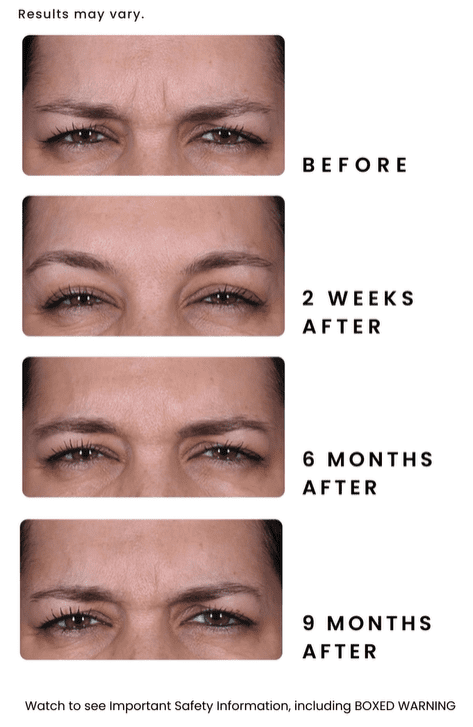
And yes, during the trial, I did see a long duration of results – 8 or 9 months in some cases. But keep in mind we only treated between the eyebrows.
I’ve now used DAXXIFY hundreds of times to treat the upper face, lower face, neck, and jaw muscles. I currently focus my use of DAXXIFY on the upper face, mostly between the brows, on the forehead, around the outside part of the eyebrows, on crow’s feet, and beside the nose. For select patients, I use it on the jaw muscles, neck and jawlines.
The differences between DAXXIFY vs Botox
As I have stated above, there is likely to be a longer duration of effect with DAXXIFY vs Botox and the other competitors. Anyone who is a candidate for Botox (or her sisters) is a DAXXIFY candidate. However, just because you are a good candidate doesn’t guarantee you will get a longer duration of effect than you might with another drug.
For my patients who don’t come in frequently for treatments (other than neuromodulators), DAXXIFY offers the opportunity to decrease the number of visits required in the course of a year while still maintaining a good effect.
There are other theoretical differences. Though the active ingredients are similar, the inactive ingredients of the five neuromodulators on the market vary quite a bit. Initially it was thought that the inactive ingredients played a role in efficacy and duration. Over time, we have learned that this is less important than we once believed.
A second difference is the role additional proteins or peptides may or may not play. Three neuromodulators, including Botox, include an added protein. DAXXIFY includes a peptide. Xeomin® has neither. According to Revance, the peptide helps the active ingredient stay in contact with cells for longer and enter the cells more effectively.
The final difference is what DAXXIFY doesn’t contain. The other four products contain human serum albumin, which helps stabilize the other ingredients. DAXXIFY does not contain it (or any human-derived products), but it doesn’t affect the efficacy.
Can DAXXIFY help you look your best?
I’ve now provided hundreds of treatments with DAXXIFY (and hundreds of thousands with the other neuromodulators), so the answer is definitely yes! If you are a good candidate for muscle-relaxing drugs, DAXXIFY can help you look your best. Most patients who I have previously treated with Botox or its sisters love the way DAXXIFY feels as well.
My staff and I are here to give advice and provide guidance to help you achieve outcomes that enhance your natural beauty, whether we use DAXXIFY, Botox, or one of the other neuromodulators.
If you value a practice that wants to give you the best possible experience and ensure you get superb results, call us at (615) 329-1110 to schedule an appointment today.
What You Need To Know Before Getting Botox and Dermal Fillers
Home » Blog » 2023
Botox® and dermal fillers are two categories of injectables that are ideal for correcting signs of aging or achieving an aesthetically pleasing look. Our entire goal when using these products is to help our patients look like themselves, but better.
If you are new to this world and worried about the possibility of having your look transformed – and not in a good way – I always suggest doing research to understand the difference between good and great outcomes. Keep in mind that experience and knowledge are important factors for the best outcomes. Physicians who are well-versed in anatomy and facial aging – and take facial balancing into account – can produce better results.
Before we go on, let’s define some terms to avoid confusion. “Dermal fillers” actually refer to soft tissue fillers. The term “dermal fillers” is no longer used by physicians, because fillers are less commonly injected into the dermis (the upper layer of the skin); rather, they are injected into soft tissue below the dermis for volumization and contouring.
Botox and other muscle-relaxing drugs (there are now 5 of them on the market in the US) are generally referred to as “neuromodulators”. When injected, neuromodulators affect the communication between muscles and nerves, which leads to muscle relaxation. Both fillers and neuromodulators are injectables.
In this article, I will walk you through everything to know before you get anything injected into your face. Let’s start with the role that injectables play to achieve facial balancing.
What is facial balancing?
To achieve beauty in a person’s face, we can use the same mathematical ratios used by the ancient Greeks to create harmonious architecture. These ratios are found throughout nature, and they are even evident in DaVinci’s paintings. Facial balancing is one of the ways in which classic principles of beauty are applied to facial enhancement or rejuvenation
In my practice, I apply the principles that underlie classic beauty and harmony to optimize a patient’s overall aesthetic. However, I don’t apply the ratios in a rigid way, otherwise my patients would look the same. I always take a patient’s unique facial anatomy into consideration so their upper, middle, and lower face are in balance.
For example, if someone has a tall forehead but the distance between their bottom lip to their chin is short, I might use an injectable in their chin to help balance those two distances and make them appear aesthetically proportionate. I would do the same for someone with prominent cheekbones and a recessed chin; enhancing the chin’s projection will help create balance.
The facial balancing concept can also help counter the effects of aging. As we age, we lose fat in our faces, and prominent facial features can become even more prominent. In this case, I look to balance the surrounding facial structure to restore a more youthful appearance.
For example, maybe someone naturally has really strong cheekbones. If they are petite and lose even a little bit of fat, the soft part of their cheeks becomes hollowed and their cheekbones appear even more prominent. By adding a dermal filler to the hollow area, their face will look softer and less harsh. In this case, the procedure is both restorative and creates aesthetically pleasing balance.
Botox and dermal fillers are my go-to products for facial balancing. Cosmetic surgery can play a role as well, but injectables allow for finer adjustments noninvasively. At the end of the day, I want to create harmony and balance and help my patients achieve natural outcomes.
The differences between injectables is probably not what you think.
There are different ways to understand dermal fillers. One approach is to consider how long the effects last. Temporary products eventually fade away but they last longer than most people think – up to a few years in many cases. Semi-permanent also last a couple of years, while permanent ones last forever. (There is only one FDA-approved permanent filler on the market called Bellafill®, and I only use it to treat depressed scars.)
Another approach to help understand fillers is the effect they produce when injected. If I want to lift your entire face, I need a “stronger” product. If I want to treat the fine lines on your upper lip, I would use a softer product. And If I am treating the area around your mouth, I would use a product that has some stretch to ensure your smile looks natural.
Semi-permanent injectables are a really interesting group, because they may be used to either provide volume or structure or, when used in a very dilute solution, to enhance skin quality. They work by stimulating or activating our bodies to produce collagen and elastin, both of which are important structural “building blocks”. Biostimulatory fillers can enhance skin quality in ways that cannot be accomplished by other means. Common areas where these products are used include the neck, chest, abdomen, above the knees, arms, and other areas. Biostimulatory products are the future of fillers.
We match products to desired outcomes.
In my practice, we use Botox and dermal fillers to achieve three outcomes:
Reduce the appearance of wrinkles and fine lines.
Botox and the other neuromodulators (Xeomin®, Daxxify®, Dsyport®, Jeuveau®) are used to relax or eliminate lines produced by facial muscle contraction (like frown lines, “crow’s feet” lines, and some forehead lines).
Soft tissue fillers may be used to treat lines that are present when our faces are at rest, including some forehead lines, lines between our eyebrows, and “smoker’s” lines on the lips.
Correction of wrinkles is perhaps the best known application of fillers but, in my practice, is actually the least commonly performed. I typically focus on first helping patients look their best from a comfortable social distance, then come back to the fine lines that sometimes are only visible in a 10x makeup mirror.
 Facial recontouring
When performing recontouring, my goal is to balance (or rebalance) a patient’s facial aesthetic. Botox and fillers can be used, often in combination, to achieve facial recontouring.
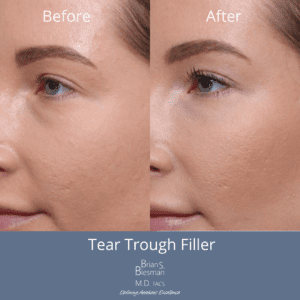
I might inject filler behind the hairline to lift the mid- and lower cheek or in the back of the jawline to support jowls that have come forward. I may also use fillers to strengthen a cheekbone or chin or change the place in which light is reflected from the face.
Similarly, Botox can enhance facial contouring when injected along the jawline, into the chin, and in other areas.
 Re-volumization
As I mentioned above, we lose volume in our face over time, a phenomenon that can lead to an aged appearance. Strategic replacement of volume with fillers can restore a more youthful contour to the eyebrows, temples, cheeks, jawline, lips, chin, and other areas.
I always restore volume in a way to ensure the entire face stays in harmony and balance. If the entire face has lost volume and only one area is treated, the outcome will not be natural or balanced.
How much downtime to expect with Botox and dermal fillers?
Patients often ask about downtime after injections. Downtime is typically caused by swelling and/or bruising. Some people don’t swell or bruise at all, some may swell and bruise a little bit, and others may do a good bit of both. I always take precautions to try to minimize both bruising and swelling. I usually tell people that if they’re worried about what people think at work, have the procedure done on a Friday. It’s always a good idea to have a little bit of downtime, just in case.
We can help you look your best.
My staff and I are here to give advice and provide guidance to help you achieve outcomes that enhance your natural beauty. We simply want to help you look like the best version of you and for your appearance to reflect the way you feel inside. We pride ourselves on bringing integrity and honesty to every conversation so you have a wonderful experience.
If you value a practice that wants to give you the best possible experience and ensure you get superb results with Botox and dermal fillers, call us at (615) 329-1110 to schedule an appointment today.
